
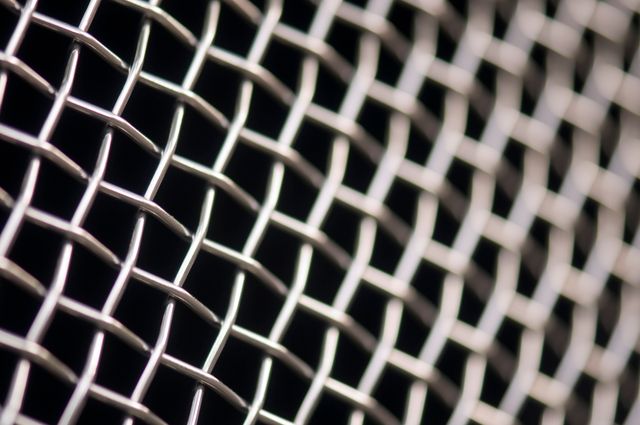
Steel bar grating is assembled from separate bars that carry load across a span. Expanded metal is a single sheet that has been slit and stretched into a diamond mesh. Grating is a floor product first. Expanded metal is mainly used as a screen, a guard, or a light walking surface.
Both products are open, both drain, and both are sold by Curtis Steel & Aluminum Co in Las Vegas. The differences below decide which one belongs in your project.
How each one is made
Bar grating
Bar grating has two kinds of bars. Bearing bars stand on edge and run in the direction of the span. Cross bars run across them, usually at a right angle, and hold the bearing bars upright and evenly spaced. The two are joined at every intersection, most often by welding. In pressure-locked grating, the cross bars are locked mechanically. A flat band is often welded around the panel edge.
Expanded metal
Expanded metal starts as a solid sheet or plate. A press slits it in a staggered pattern and stretches it, which opens the slits into diamonds. No welding is involved and no material is removed, so the finished piece is one continuous part. Our earlier post on what expanded metal is covers the process in more detail.
Expanded metal comes in two surfaces. Standard, or raised, expanded metal keeps the angled strands left by the press. Flattened expanded metal has been rolled smooth.
How each one carries load
This is the difference that matters most. In bar grating, the bearing bars do the work. They span from one support to the next and deliver the load to those supports. Cross bars are light, sometimes only a quarter-inch rod, and they are not meant to carry weight.
Direction is therefore part of the order. A panel cut so that the cross bars span the opening will fail early, and suppliers see that mistake often. Tell the supplier which dimension is the span.
Expanded metal carries load through its network of strands. The light styles used for guards and screens are not floor products. For foot traffic, there is a heavier family called expanded metal grating, and a version called catwalk grating made for pedestrian walkways. Direction matters here too: the long way of the diamond is set across the shorter span.
How to read the callouts
The two products are specified in different languages, which is where many ordering mistakes start.
- Bar grating uses a code such as 19W4. The 19 means bearing bars spaced 19/16 inch on center, or 1-3/16 inches. The W means welded. The 4 means cross bars every 4 inches. The bearing bar size, such as 1 inch by 3/16 inch, is given separately.
- Expanded metal uses a style name such as 3/4 inch No. 9, followed by standard or flattened.
- Expanded metal grating is called out by weight, in pounds per square foot.
Because the systems differ, a drawing that says only “grating” is not enough to quote from. Send the full callout or a description of the load and span.
Surface and traction
Bar grating comes with a plain or a serrated top. Serrated bearing bars are notched for grip and are chosen where the surface will be wet or oily. Raised expanded metal has natural traction from its angled strands. Flattened expanded metal is smoother underfoot and against the hand, which suits shelving, infill panels, and guards people will touch.
Where each one fits
Choose bar grating for:
- Mezzanines, platforms, and industrial floors
- Stair treads and landings
- Trench and drain covers
- Any span that carries carts, pallets, or equipment
Choose expanded metal for:
- Machine guards and safety screens
- Vent covers and infill panels
- Security and fencing panels
- Shelving, racks, and decorative work
Expanded metal grating sits between the two. It suits catwalks, ramps, and light platforms where the spans are short and the traffic is on foot. Our steel grating in Las Vegas range includes grating, decking, and expanded metal, so the three can be compared side by side.
Open area, light, and airflow
Both products let water, light, and air through, which is why they replace solid plate on outdoor platforms and over drains. Bar grating has long, narrow openings that shed debris well. Expanded metal has smaller diamond openings, which stop dropped tools and fingers more reliably. If you need a fully closed surface, a solid sheet is the answer, and our comparison of expanded metal vs sheet metal explains that choice.
Material and finish
Carbon steel is the most common material for both. Bare steel will corrode outdoors, so grating is usually hot-dip galvanized or painted, and expanded metal is available galvanized as well. Aluminum reduces weight. Stainless steel is used where corrosion resistance comes first, such as food plants and chemical areas.
Cutting and fitting
Cutting affects the two products differently. A cutout in bar grating removes the support for some bearing bars, so the opening is finished with a band that carries their load. A cut edge on expanded metal leaves open strands that are sharp. Guard and infill panels are usually framed in angle or flat bar for that reason.
What to have ready when you order
- The product and its callout, if you have one
- Panel width and length, with the span direction marked
- The load: foot traffic, carts, or vehicles
- Plain or serrated surface for grating, raised or flattened for expanded metal
- Finish: bare, painted, or galvanized
- Any cutouts, notches, or banding
Material can be collected from our Las Vegas yard or drop-shipped. Buyers looking for metal and steel suppliers in Phoenix are served from the same stock.
Frequently asked questions
1) Can you walk on expanded metal?
Not on the light styles sold for guards and screens. Expanded metal grating and catwalk grating are made for foot traffic. Check the load table for the span before you use either as a walking surface.
2) Is bar grating stronger than expanded metal?
For floors and longer spans, yes. Bearing bars stand on edge, which is an efficient way to carry load between supports. Expanded metal grating handles lighter, shorter spans.
3) What does 19W4 mean on a grating order?
Bearing bars are spaced 1-3/16 inches on center, the grating is welded, and cross bars are 4 inches apart. The bearing bar depth and thickness are listed separately.
4) Which way should the bearing bars run?
Across the opening, from support to support. The cross bars only hold the bearing bars in position and should never be the bars that span the gap.
5) Can both products be galvanized?
Yes. Steel bar grating is commonly hot-dip galvanized after fabrication, and expanded metal is available in galvanized steel. Cut edges should be touched up.
Conclusion
If the surface has to carry real load across a span, start with bar grating. If it has to guard, screen, or cover, start with expanded metal. For a light walkway, compare expanded metal grating against a light bar grating.
Tell us the span, the load, and the size of the opening, and we will price the options. Contact Curtis Steel & Aluminum Co or call 702.952.3000.